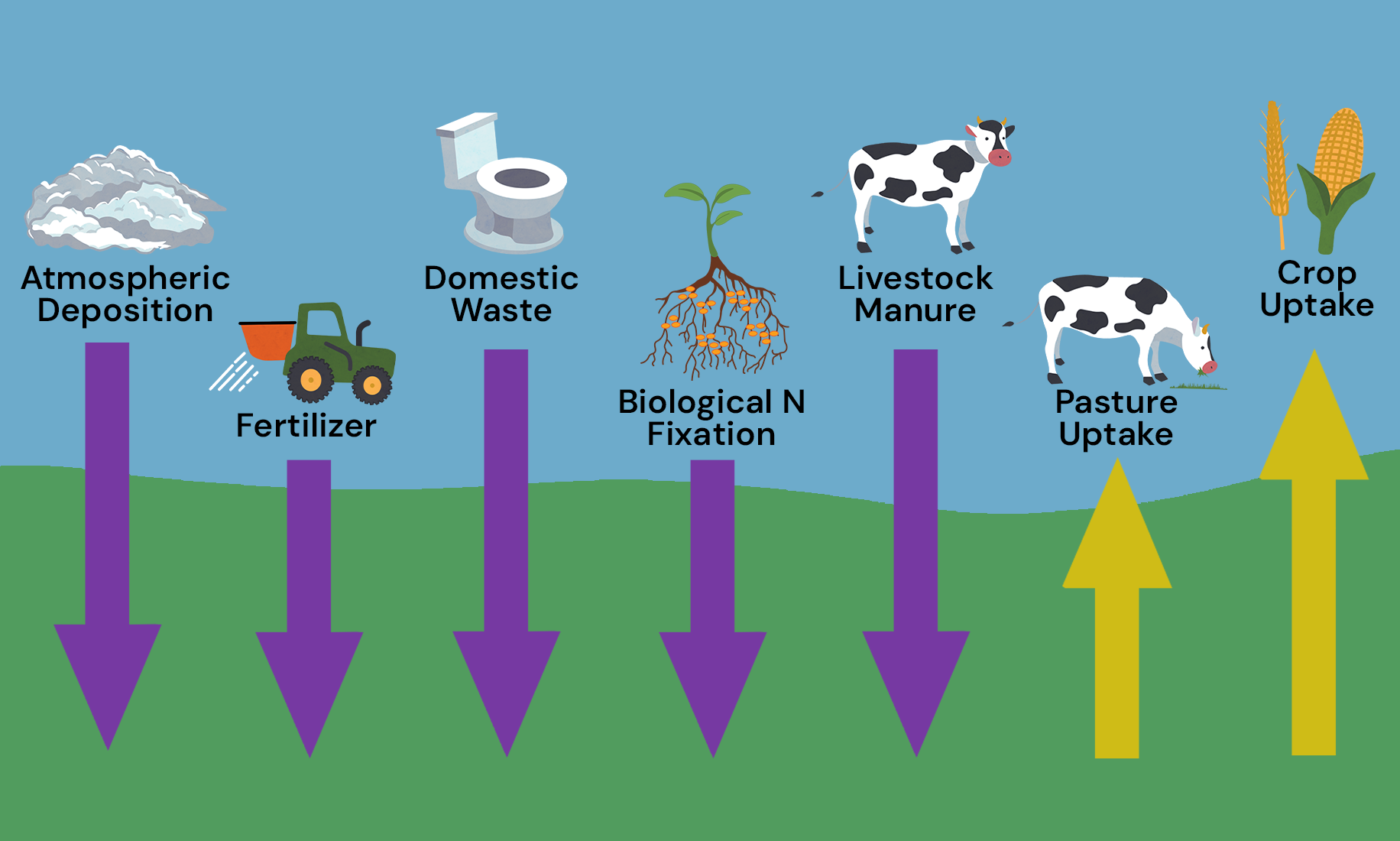
The Trajectories Nutrient Datasets (TREND) are multi-year nutrient input, output, and surplus datasets. Inputs include fertilizer, livestock manure, biological nitrogen fixation, atmospheric deposition, and domestic waste. Outputs include crop removal, while surplus is calculated as the difference between inputs and outputs.
These data products are being developed across North America using information from datasets such as the census of agriculture, population census, and literature-based coefficients. TREND is designed to support research into spatial and temporal changes in anthropogenic nutrient dynamics.
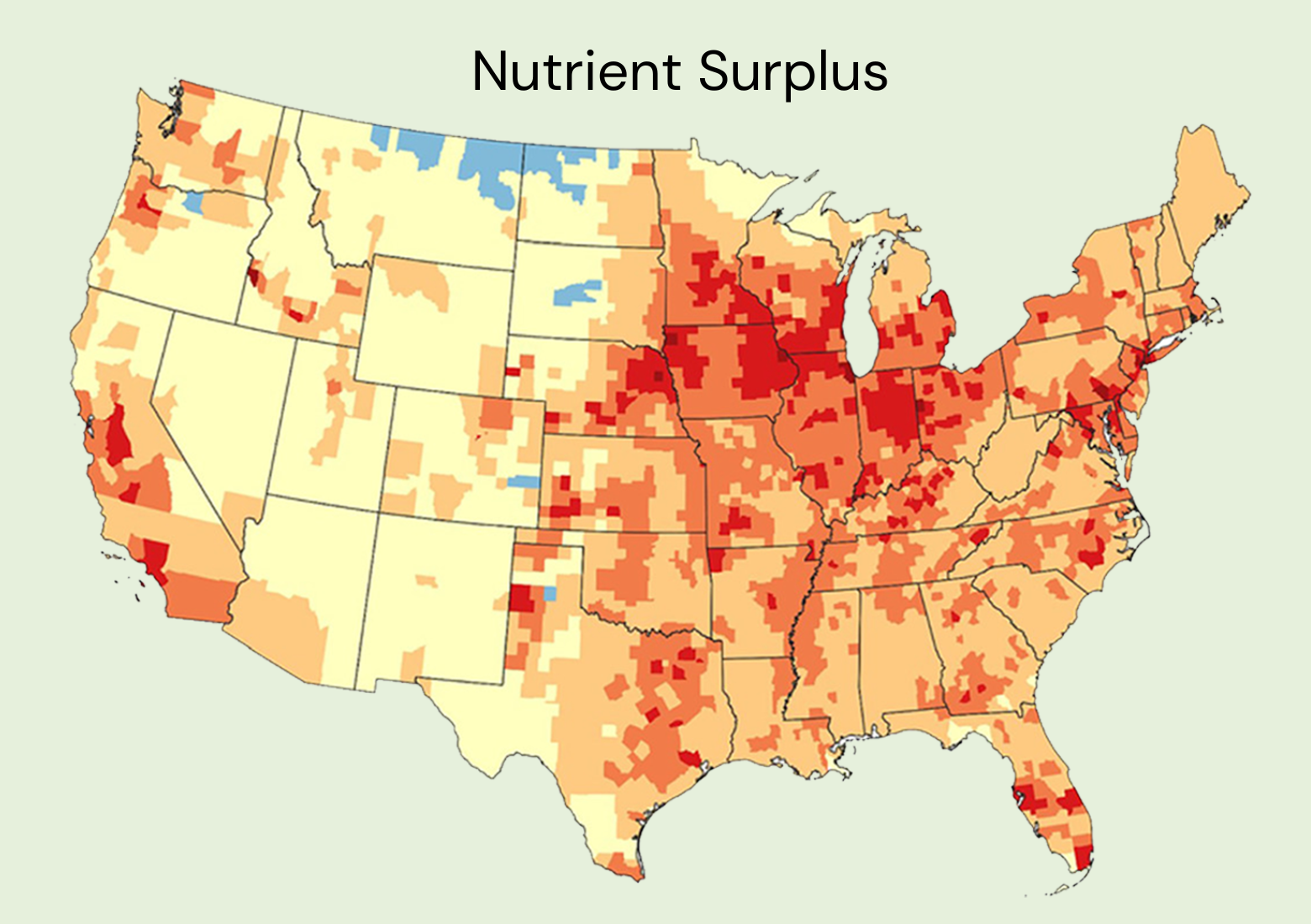
Currently, the portal displays nitrogen budgets in the United States from 1930 to 2017, and phosphorus budgets across Canada from 1961 to 2016. The next version of the website will include both nitrogen and phosphorus budgets across North America.
The data products are developed at the county scale, an administrative unit where census data is easily available. Future versions will also provide information at the 250-m grid scale and aggregate results to the watershed scale.
Information on synthetic fertilizer use is based on fertilizer sales data available at the county scale in the United States and the provincial scale in Canada. The county-scale United States fertilizer use dataset was created by stitching together three datasets: Cao et al. (2018) for 1930-1944, Alexander and Smith (1990) for 1945-1985, and Brakebill and Gronberg (2017) for 1987-2012. For Canada, provincial fertilizer sales data were distributed to counties based on harvested crop area in each province.
Biological nitrogen fixation is the process where microorganisms living in root nodules of leguminous plants convert atmospheric nitrogen gas into plant-available forms such as ammonia. For the United States, biological nitrogen fixation was estimated using crop area and yield-based methods for major nitrogen-fixing crop types, including soybean, peanuts, lentils, dry beans, hay, and cropland pasture.
Livestock manure was estimated using county-scale livestock inventory data from the United States and Canadian agricultural census, along with animal-specific nitrogen and phosphorus coefficients that account for changing livestock weights over multiple decades. Manure estimates were calculated for major livestock categories and aggregated to estimate total manure.
Domestic waste includes nitrogen and phosphorus in human excreta, as well as phosphorus from laundry and dish detergents. It is estimated using population census data, nitrogen and phosphorus content in human excreta, and literature estimates of phosphorus content in detergent over time. These estimates are prior to wastewater treatment, because treatment efficiency varies by location and has changed substantially over the past several decades.
Throughout the growing season, crops take up nitrogen and phosphorus from the soil and store these nutrients in their biomass. During harvest, the stored nutrients are removed from the system. Crop nutrient removal is estimated using county-scale harvested area and crop yield data from Canadian and United States census sources, along with crop-specific nutrient content estimates from the literature.
Nutrient surplus is defined as the difference between all nutrient inputs and outputs. Each component is calculated at the county scale in units of kg N ha-1 yr-1 and kg P ha-1 yr-1.
Nutrient Surplus = Inorganic Fertilizer + Livestock Manure + Atmospheric Deposition + Biological Fixation + Domestic Waste - Crop Removal - Pasture Removal
Further details on these methodologies are provided in Byrnes et al. (2020) and Malik (2021).